Sampling Variability, Standard Error, Simulation Intuition, and Uncertainty
Overview
Statistical inference helps us use data from a sample to learn about a larger population. In public health, we often do not have access to an entire population, so we rely on sample data to estimate population values and quantify uncertainty.
In this lesson, we will introduce the foundational ideas behind statistical inference, including sampling variability, standard error, simulation intuition, and the connection between observed data and uncertainty.
Learning Objectives
By the end of this lesson, students will be able to:
Define statistical inference in the context of public health research
Explain sampling variability and why sample estimates differ
Define and interpret the standard error
Use simulation to build intuition about uncertainty
Explain how confidence intervals connect data to uncertainty
Interpret results from estimation procedures in plain language
Assigned Readings
OpenIntro Biostatistics, Chapter 3
Statistical Inference via Data Science, Chapter 8: Estimation, Confidence Intervals, and Bootstrapping
What Is Statistical Inference?
Statistical inference is the process of using sample data to draw conclusions about a population.
For example, researchers may want to estimate:
the average body mass index in a community
the proportion of adults who are up to date on cancer screening
the difference in blood pressure between two treatment groups
Because these values are usually unknown for the full population, we use sample statistics to estimate them.
From Sample to Population
A population is the full group we want to understand.
A sample is the subset of that population that we actually observe.
A parameter is a numerical summary of the population, such as a population mean or population proportion.
A statistic is a numerical summary calculated from the sample, such as a sample mean or sample proportion.
Statistical inference uses sample statistics to estimate unknown population parameters.
Sampling Variability
One of the most important ideas in inference is sampling variability.
If we take many different random samples from the same population, the sample results will not be exactly the same each time. This happens because each sample contains slightly different observations.
That natural variation from sample to sample is called sampling variability.
Why Sampling Variability Matters
Sampling variability explains why we should not expect one sample statistic to equal the true population value exactly.
It also explains why we need tools like:
standard errors
confidence intervals
bootstrap distributions
hypothesis tests
These tools help us measure and communicate uncertainty.
Example: Simulating a Population
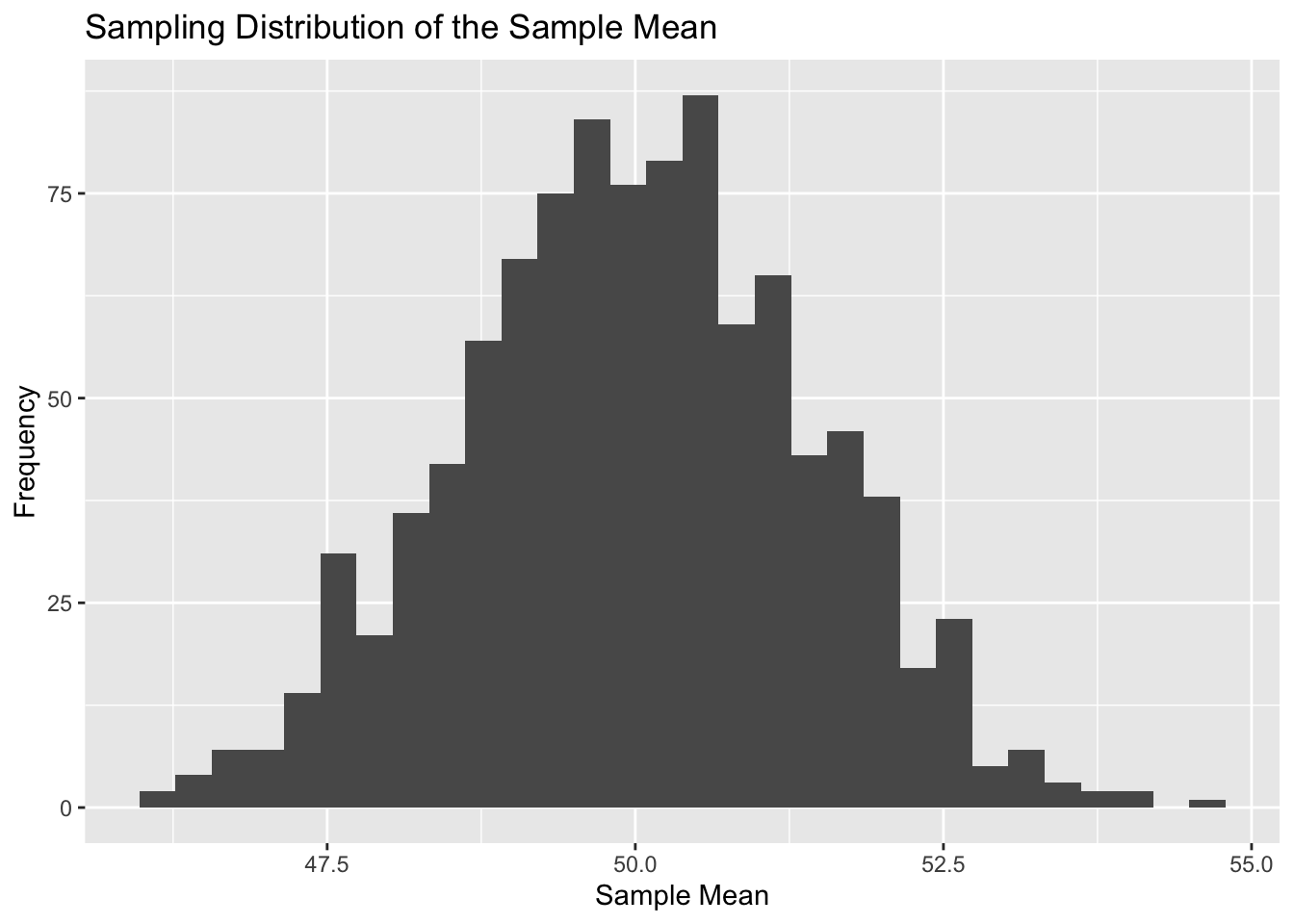
In the example below, we create a population and repeatedly draw samples from it. Then we compute the sample mean for each sample.
library(tidyverse)
Warning: package 'dplyr' was built under R version 4.5.1
── Attaching core tidyverse packages ──────────────────────── tidyverse 2.0.0 ──
✔ dplyr     1.2.0     ✔ readr     2.1.5
✔ forcats   1.0.0     ✔ stringr   1.5.1
✔ ggplot2   3.5.2     ✔ tibble    3.2.1
✔ lubridate 1.9.4     ✔ tidyr     1.3.1
✔ purrr     1.0.4
── Conflicts ────────────────────────────────────────── tidyverse_conflicts() ──
✖ dplyr::filter() masks stats::filter()
✖ dplyr::lag()    masks stats::lag()
ℹ Use the conflicted package (<http://conflicted.r-lib.org/>) to force all conflicts to become errors
set.seed(123)population <-tibble(value =rnorm(10000, mean =50, sd =10))head(population)
# A tibble: 6 × 1
  value
  <dbl>
1  44.4
2  47.7
3  65.6
4  50.7
5  51.3
6  67.2
Repeated Sampling
Now we take many random samples of size 50 and calculate the mean for each sample.
A 95% confidence interval gives a range of plausible values for the true population mean.
A correct interpretation is:
We are 95% confident that the true population mean lies between the lower and upper confidence limits.
For this sample, the interval is:
48.63 to 54.61
Important Note About Confidence Intervals
A confidence interval does not mean that 95% of individual observations fall in that range.
It also does not mean there is a 95% probability that the fixed population parameter changes from sample to sample.
Instead, it means that if we repeated this process many times, about 95% of similarly constructed intervals would capture the true population parameter.
Connecting Data to Uncertainty
One of the main goals of inference is to connect sample data to uncertainty in a transparent way.
When we report only a single estimate, such as a sample mean, we are not showing how much that estimate could vary.
When we report:
a standard error
a confidence interval
a bootstrap distribution
we give readers more information about the strength and precision of the estimate.
Public Health Example
Suppose a study estimates that 72% of women in a sample are up to date on screening.
That number is useful, but it is incomplete by itself.
If the study also reports a 95% confidence interval of 68% to 76%, we now understand that:
the estimate is not exact
there is sampling uncertainty
the true population value is plausibly somewhere in that interval
This is why uncertainty matters in public health decision-making.
Key Terms
Term
Definition
Population
The full group of interest
Sample
The observed subset of the population
Parameter
A numerical summary of a population
Statistic
A numerical summary of a sample
Sampling Variability
The natural variation in sample results from one sample to another
Standard Error
The typical variability of a sample statistic across repeated samples
Bootstrap
A resampling method used to estimate uncertainty
Confidence Interval
A range of plausible values for a population parameter
Worked Example Summary
We used a simulated population to show that:
different samples produce different means
the distribution of sample means reflects sampling variability
the standard error summarizes the variability of an estimate
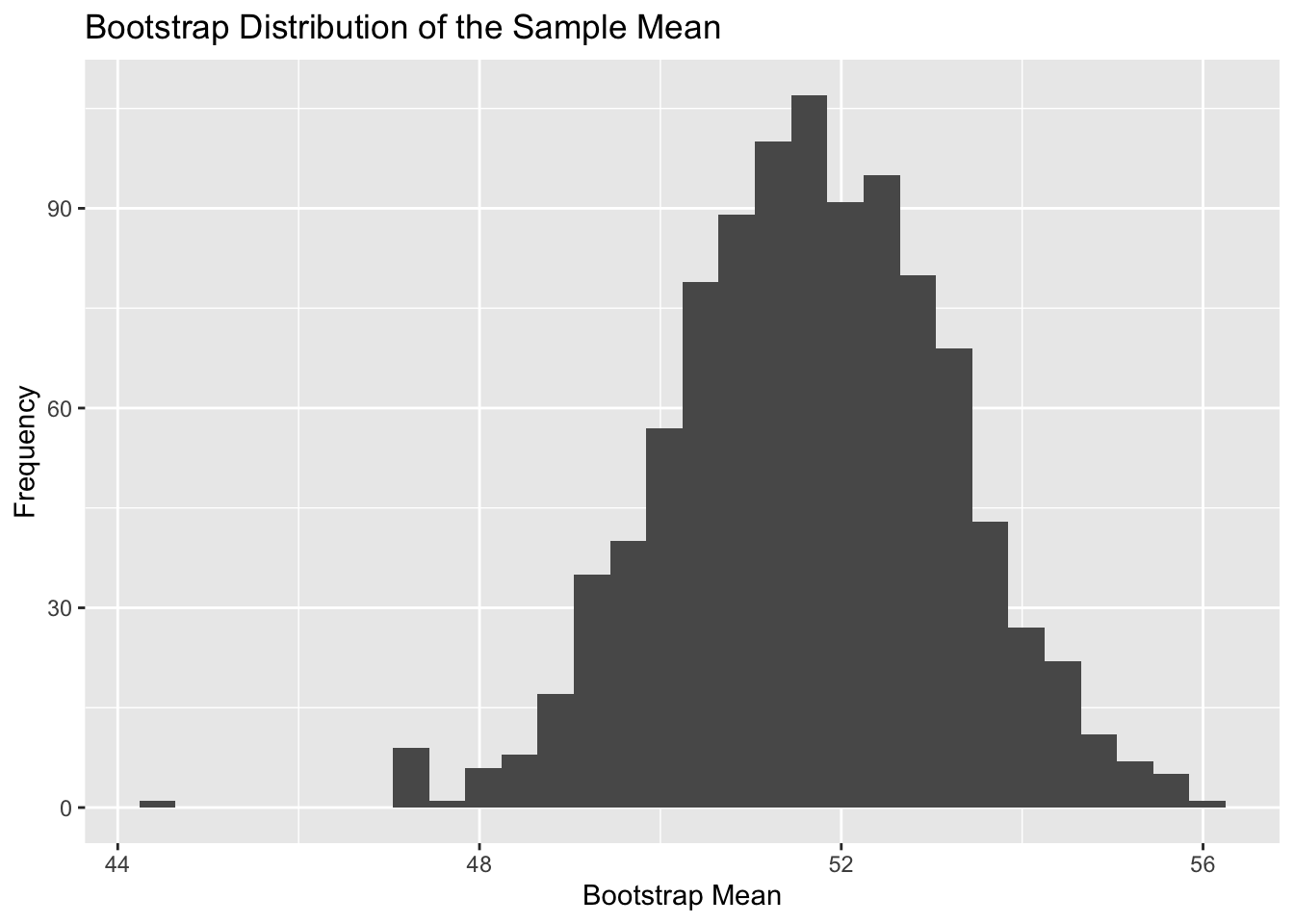
bootstrap methods provide a simulation-based way to estimate uncertainty
confidence intervals help communicate plausible values for the population parameter
Practice Activity
Use the steps below to practice the ideas from this lesson.
Draw a random sample of size 50 from a dataset.
Calculate the sample mean.
Calculate the standard deviation.
Calculate the standard error.
Construct a 95% confidence interval.
Repeat using a sample of size 200.
Compare the standard errors and confidence interval widths.
Reflection Questions
Answer the following questions after completing the activity:
Why do sample estimates change from one sample to another?
What does the standard error tell us?
How did increasing the sample size affect the standard error?
How did increasing the sample size affect the confidence interval?
Why is it important to report uncertainty in public health research?
Common Misconceptions
Here are a few common misunderstandings to avoid:
Sampling variability does not mean the study was done incorrectly.
A larger sample does not remove all uncertainty, but it usually reduces it.
A confidence interval does not describe where most individual observations fall.
Bootstrapping does not create new data from the population; it resamples the observed sample.
Conclusion
Statistical inference allows us to move from data to evidence-based conclusions about a larger population.
Because every sample is only one possible sample, all estimates come with uncertainty.
Sampling variability explains why estimates differ, the standard error quantifies that variability, simulation helps us visualize it, and confidence intervals help us communicate it clearly.
These ideas form the foundation for later topics such as hypothesis testing, p-values, and statistical modeling.
Looking Ahead
In the next lesson, we will build on these ideas by introducing hypothesis testing, p-values, and the logic of decision-making under uncertainty.